
MiSeq™ i100 Chemistry Overview: What Clients Need to Know When Transitioning from 4‑Colour MiSeq Systems
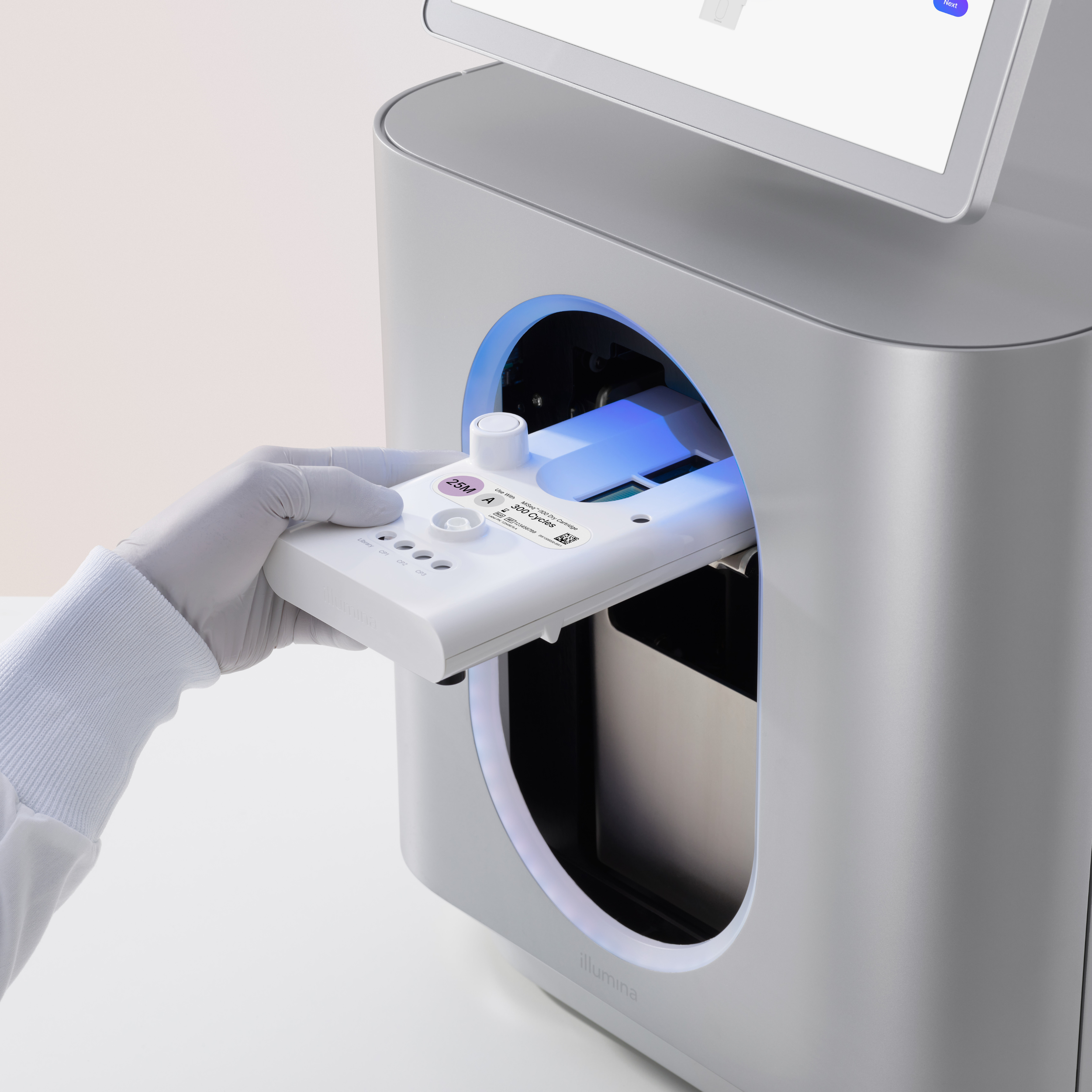
IMAGE CREDIT: ILLUMINA
AGRF has moved to the MiSeq™ i100 Series, so you get faster turnaround, more reliable performance, and future‑proof support.
The i100 uses Illumina’s modern 2‑channel XLEAP‑SBS chemistry (the same chemistry family used on NextSeq and NovaSeq), which simplifies imaging and speeds up run-time while maintaining high data quality. For most projects, no pipeline changes are needed. If you’re comparing new data to legacy 4‑colour MiSeq datasets, our team can advise on best‑practice alignment and QC.
Bottom line: You’ll see the same trusted results, delivered faster, with a platform that will be supported long‑term.
The MiSeq™ i100 Series uses Illumina’s modern XLEAP‑SBS chemistry, the same robust sequencing chemistry deployed across the NovaSeq and NextSeq platforms. These platforms use highly efficient streamlined multichannel imaging systems, replacing the traditional four‑colour method used in legacy MiSeq instruments.
How the chemistries differ
In the legacy 4‑colour SBS system, each nucleotide is labelled with a dedicated fluorophore and detected across four independent imaging channels. This provides direct, base‑specific emission signals.
In contrast, the MiSeq i100 employs a 2‑channel imaging system:
T → green channel
C → blue channel
A → combined blue + green signal
G → no fluorescence (“dark base”)
This approach allows all four bases to be resolved using just two images per cycle, dramatically simplifying the imaging workflow.
Why this matters for your projects
The transition to 2‑channel chemistry brings several advantages:
Reduced imaging complexity and fewer moving optical components
Faster cycle times and more efficient data generation
Modern, more robust chemistry (XLEAP‑SBS) used across Illumina’s newest platforms
Improved practical workflow, including simplified consumables and fast onboard processing
Broad compatibility with a wide range of common applications, including amplicon sequencing, small genomes, microbial genomics, and QC workflows
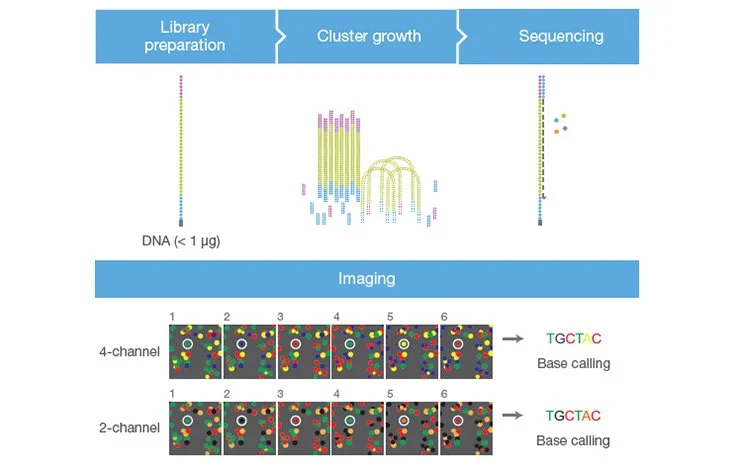
image credit: Illumina
What clients should expect when comparing data across chemistries
Both 4‑colour and 2‑colour systems deliver consistently high sequence accuracy. However, because the detection systems differ, signal intensity profiles, base‑quality distributions, and error signatures may not be identical across platforms. These differences are well‑characterised and expected.
For most applications:
No special calibration or pipeline changes are required.
However, if you are performing:
longitudinal or time‑series studies,
comparative studies mixing historical and new data, or
re-analyses of legacy datasets from 4‑colour MiSeq instruments,
You should remain aware of these chemistry‑based differences. Small variations may appear in lower‑level quality metrics, and pipelines should be configured to appropriately accommodate the characteristics of 2‑channel XLEAP‑SBS data.
AGRF’s bioinformatics team can provide guidance to ensure consistency across mixed‑chemistry datasets if required.
Why AGRF is transitioning to the MiSeq i100 Series
The MiSeq i100 Series represents the future of benchtop sequencing for Illumina platforms. Its improved chemistry, simplified workflow, higher efficiency, and alignment with Illumina’s broader technology roadmap mean it delivers:
greater reliability
faster turnaround times
increased data efficiency
long‑term continuity and support
As legacy 4‑colour MiSeq instruments are gradually phased out by Illumina, the MiSeq i100 Series ensures that your sequencing projects continue uninterrupted on a robust, modern, and well‑supported platform.
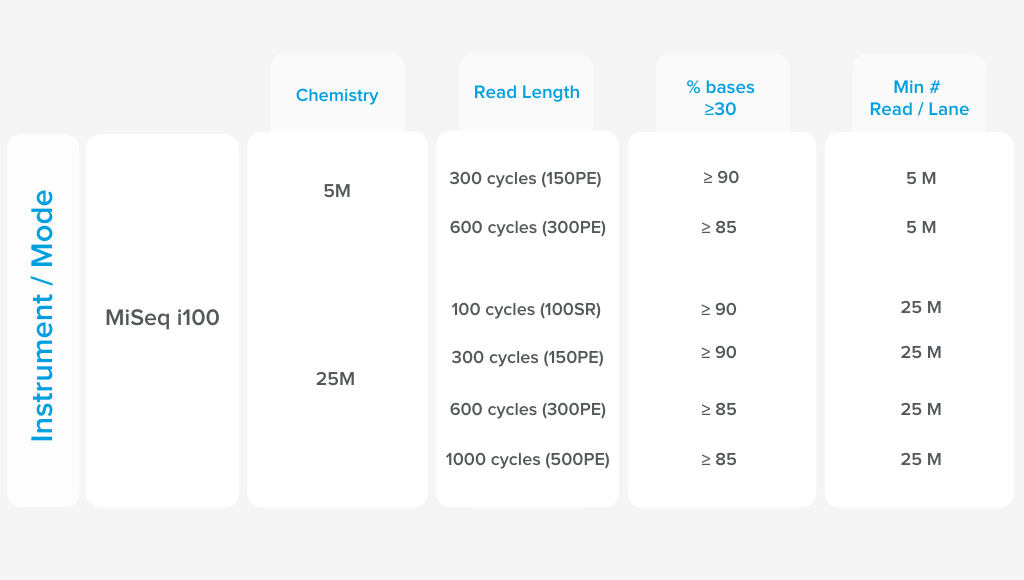
Sequencing Configuration Options Available for the MiSeq i100
FAQ’s
Q1. Will my data look the same?
A. Yes for practical purposes. Both chemistries deliver high accuracy. Metrics like Q30 and overall call quality remain strong. Minor differences in signal patterns and error signatures are expected when comparing across chemistries, but they rarely impact typical analyses. The i100 Series instruments will output the same fundamental raw data file types (BCL‑based primary data) as the legacy MiSeq, ensuring full compatibility with existing Illumina workflows and downstream analysis pipelines.
Q2. What about index design and colour balance?
A. With modern 2‑channel/XLEAP chemistry, ensure balanced index bases (especially at early cycles) to keep Q‑scores robust. AGRF’s library guidelines include ready‑to‑use, balanced index sets.
Q3. Are there any known artefacts in 2‑channel data?
A. At typical depths, artefacts are well‑controlled and don’t affect routine analyses.
Q4. Why move now?
A. The i100 delivers faster TAT, simplified workflows, and long‑term platform support that aligns with Illumina’s roadmap, while legacy 4‑colour MiSeq instruments are being phased out.